It is just not information security professionals like me complaining about privacy issues on social networking sites, others are taking a hard look at this as well including the US Federal Trade Commission (FTC). I reported in an earlier post that US Senators send a letter to Facebook, now FTC gets involved in a complaint against Twitter.
FTC issues an administrative complaint when it has "reason to believe" that the law has been or is being violated, and it appears to the Commission that a proceeding is in the public interest. FTC employs the FTC Act to impose sanctions on firms that exhibit unfair or deceptive practices, such practices that they feel would likely result in the disclosure of personal information.
There has been many similar complaints in the past but this is the first case against a social networking service.
According to the FTC's press release, Twitter has agreed to settle FTC charges that it deceived consumers and put their privacy at risk by failing to safeguard their personal information. According their complaint, some of the breaches on Twitter system were possible due to a failure to implement reasonable safeguards. The complaint originated from some of the high profile breaches including that of Barack Obama before he became the President.
According to FTC, Twitter failed to implement some of the following safeguards:
* requiring employees to use hard-to-guess administrative passwords that are not used for other programs, websites or networks;
* prohibiting employees from storing administrative passwords in plain text within their personal email accounts;
* suspending or disabling administrative passwords after a reasonable number of unsuccessful login attempts;
* providing an administrative login webpage that is made known only to authorized persons and is separate from the login page for users;
* enforcing periodic changes of administrative passwords by, for example, setting them to expire every 90 days;
* restricting access to administrative controls to employees whose jobs required it; and
* imposing other reasonable restrictions on administrative access, such as by restricting access to specified IP addresses.
As part of the settlement, Twitter is required to implement a variety of data security safeguards including "a comprehensive information security program, which will be assessed by an independent auditor every other year for 10 years".
The main document of FTC complaint is here
Some of safeguards mentioned even though highly important, these are very hard to implement for many small businesses. FTC has some strong words for organizations in what they claim they do in terms of securing consumer information.
"When a company promises consumers that their personal information is secure, it must live up to that promise,"
I touched the topic of do we really need more regulations in the privacy area, here. For many organizations, there is no incentive to spending money on security related activities, this is where the value of regulations comes in. Data privacy regulations require organizations to invest in a minimum level of security controls. Such minimum level of security controls reduce the probability of a data breach and resulting harm.
Even though many of the US and other countries privacy laws mandate only "reasonable" or minimum security, for many businesses that is not enough. While discussing the new Massachusetts privacy law I commented this:
"organizations should look at this and other regulatory requirements as "minimum standards" and look upon setting up a higher level for themselves. Remember that Compliance != Security"
The key takeaway is that organizations must take a hard look at their privacy policies and implement the specified controls to safeguard customer information. Information security practitioners should convey this to their business and technology leaders and implement such protection mechanisms or face sanctions.
Sunday, June 27, 2010


Tuesday, June 22, 2010
Wireless Penetration Testers... SANS need your input
I received this from the SANS mailing list for GIAC certified folks.
The GIAC Wireless Penetration Testing and Ethical Hacking (GAWN) JTA
committee has recommended an updated set of certification objectives, and we
are conducting a formal Job Task Analysis. We are seeking Wireless Security
subject matter experts to vote on proposed changes and rate the relevance of
each certification objective.
If you have wireless security background and experience, especially if the
experience involves penetration testing your input will be valuable in
shaping this certification. Please note that if your background does not
include experience with wireless security, we are unable to use your input
for the survey at this time.
Your name may be listed in the validation report if this certification is
submitted for ANSI accreditation. This survey will take an estimated 15
minutes of your time and can be accessed at the link below. The survey will
be available through 12:01 AM on 7/1.
https://www.surveymonkey.com/
Thank You.
Chris Carboni
GIAC Technical Director
GCIH, GSNA, GCWN, GCFA
Saturday, June 12, 2010
Data leaks, 0-days, and mass infections
June so far has been a busy month for 0-days, data leaks, and mass infections. If this is not news for you, jump to the analysis section at the end.
Windows 0-day
A new vulnerability has been identified and POC code has been published for this Windows 0-day affecting the help functionality.
Windows use what is called as HCP protocol when the helpctr.exe executable is invoked to open the help files and connect using the HCP URI. HCP is similar to the HTTP protocol and uses a similar prefix hcp://
The vulnerability is due to not validating URLs while using the HCP protocol, this allows passing arbitrary scripts to the operating system. In order to exploit this vulnerability, one has to invoke the help file to connect to a specially crafter URL. Such specially crafted URL could be sent in an email enticing the user to click on it. Once exploited, the adversary could assume the rights of the logged in user. So, if the user is logged on with administrative privileges, the adversary could take over the entire system.
Microsoft issued an advisory and recommends removing or unregistering the HCP protocol through a registry setting.
The full disclosure and the POC is here and the Microsoft advisory is here
If you recall, this is not the first time vulnerabilities have come up in the "help" function. Here are the last two announcemets.
Mass script injection attacks
Several sites were the victims of a mass script injection attacks. The common point was that all were running ISS/ASP.net, the general behavior which is observed on the affected sites include insertion of a particular script (ex: "http://ww.robint.us/u.js").
Another round of injection attacks was reported yesterday, affecting about 1000 sites. This time the script points to "2677.in/yahoo.js".
More information available here, here, and here
Wordpress script injection attacks
Thousands of WordPress blogs and other PHP-based sites were the victims of injection attacks, they were injected with a malicious script aimed at infecting visitor's machines with rogue security products.
More information, available here
AT&T iPad owners email leak
Gawker reported that they were given data on 114,000 iPad user accounts by intruders who hacked an AT&T server.
As per the technical details released by Gawker, it involved spoofing the user-agent in the header to make AT&T's servers respond to a request for harvesting the data.
Analysis
What's common on all these attacks?
It is input validation.
Input validation is the source of various attack techniques such as buffer overflows, cross-site scripting, SQL injection, and manipulation (query string, form field, cookie, header, etc). Input validation refers to how the application filters, scrubs, or rejects input. Proper validation should be done for variety of inputs such as type, length, format, and range.
Detection and prevention methods include
Windows 0-day
A new vulnerability has been identified and POC code has been published for this Windows 0-day affecting the help functionality.
Windows use what is called as HCP protocol when the helpctr.exe executable is invoked to open the help files and connect using the HCP URI. HCP is similar to the HTTP protocol and uses a similar prefix hcp://
The vulnerability is due to not validating URLs while using the HCP protocol, this allows passing arbitrary scripts to the operating system. In order to exploit this vulnerability, one has to invoke the help file to connect to a specially crafter URL. Such specially crafted URL could be sent in an email enticing the user to click on it. Once exploited, the adversary could assume the rights of the logged in user. So, if the user is logged on with administrative privileges, the adversary could take over the entire system.
Microsoft issued an advisory and recommends removing or unregistering the HCP protocol through a registry setting.
The full disclosure and the POC is here and the Microsoft advisory is here
If you recall, this is not the first time vulnerabilities have come up in the "help" function. Here are the last two announcemets.
Vulnerability in HTML Help ActiveX Control Could Allow Remote Code Execution
Mass script injection attacks
Several sites were the victims of a mass script injection attacks. The common point was that all were running ISS/ASP.net, the general behavior which is observed on the affected sites include insertion of a particular script (ex: "http://ww.robint.us/u.js").
Another round of injection attacks was reported yesterday, affecting about 1000 sites. This time the script points to "2677.in/yahoo.js".
More information available here, here, and here
Wordpress script injection attacks
Thousands of WordPress blogs and other PHP-based sites were the victims of injection attacks, they were injected with a malicious script aimed at infecting visitor's machines with rogue security products.
More information, available here
AT&T iPad owners email leak
Gawker reported that they were given data on 114,000 iPad user accounts by intruders who hacked an AT&T server.
As per the technical details released by Gawker, it involved spoofing the user-agent in the header to make AT&T's servers respond to a request for harvesting the data.
Analysis
What's common on all these attacks?
It is input validation.
Input validation is the source of various attack techniques such as buffer overflows, cross-site scripting, SQL injection, and manipulation (query string, form field, cookie, header, etc). Input validation refers to how the application filters, scrubs, or rejects input. Proper validation should be done for variety of inputs such as type, length, format, and range.
Detection and prevention methods include
- Network IPS, which can look at the script inserts and alert
- Host IPS and file integrity monitoring tools
- Web application firewalls that can block the inline scripts.
- Log monitoring - Proper log monitoring can identify script and file injection attacks
- URLSCAN - This Microsoft tool is an ISAPI filter that intercepts every request the web server receives from the Internet and scans each request for anything unusual such as scripts.
- URLRewrite - Another tool, it has similar functionality as the URLSCAN. The major difference is that with URLREWRITE allows you define regular expressions, so it is much more flexible and powerful.
One interesting aspect that you may have noticed is the India connection in the mass injection attacks, specifically the domain 2677.in has an India TLD. Let's try to get more information on this.
lab:$ whois 2677.in
Domain ID:D4266272-AFIN
Domain Name:2677.IN
Created On:10-Jun-2010 10:33:51 UTC
Last Updated On:10-Jun-2010 10:33:52 UTC
Expiration Date:10-Jun-2011 10:33:51 UTC
Sponsoring Registrar:Transecute Solutions Pvt. Ltd. (R120-AFIN)
Status:CLIENT TRANSFER PROHIBITED
Status:TRANSFER PROHIBITED
Registrant ID:TS_11029084
Registrant Name:liu xiaowei
Registrant Organization:liu xiaowei
Registrant Street1:huang he lu 28 Hao
Registrant Street2:
Registrant Street3:
Registrant City:zhou zhou
Registrant State/Province:henan
Registrant Postal Code:450001
Registrant Country:CN
This has an India TLD but registered in China. Let's look at where is it hosted
lab:$ host 2677.in
2677.in has address 95.211.130.71
lab:$whois 95.211.130.71
OrgName: RIPE Network Coordination Centre
OrgID: RIPE
Address: P.O. Box 10096
City: Amsterdam
StateProv:
PostalCode: 1001EB
Country: NL
So, as you can see, it was registered in China, has an India domain but hosted in Netherlands. This shows the international reach of cyber criminals making it difficult for organizations and law enforcement to act against them.
Sunday, June 6, 2010
Another Adobe 0-day
Adobe announced a new vulnerability affecting Flash and Reader products. As per the report, this is being actively exploited in the wild.
Over the past year or so we started seeing more PDF reader based attacks and there have been numerous exploits during this time. A recent report published by f-secure confirms this.
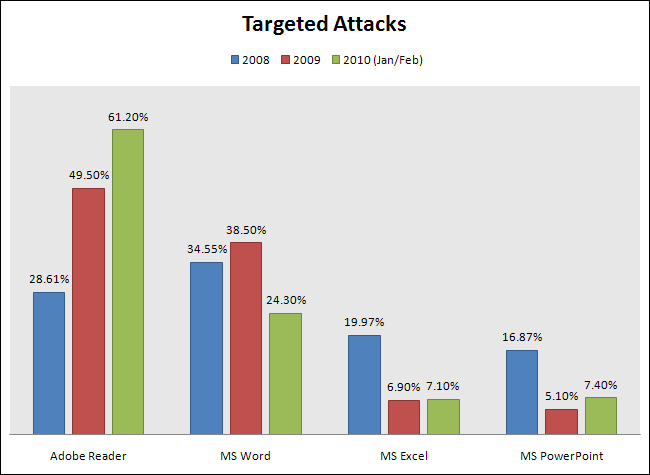
Source: f-secure
Last year, some of the major Reader vulnerabilities included the JavaScript bugs, the JBIG2 compression algorithm vulnerabilities, and memory corruption vulnerabilities.
Back in March this year, Didier Stevens published another interesting attack, he discussed a POC relating to the /launch functionality in PDF files. More information is available here.
So, with Adobe PDF Reader having all these vulnerabilities, what are our options?
Online services like Google Docs can display pdf documents right in the web browser. The advantage of this method is that the pdf is not executed on the user's computer system which means that any exploits will have no effect.
Firefox has a plugin to open PDF documents in Google Docs, this plugin, GPDF can be found from the Mozilla repository.
Saturday, June 5, 2010
More on Cloud Computing
In my three part essay (here, here, and here) on Cloud Computing, I covered mainly the security concerns and how organizations can prepare themselves before getting to cloud based computing solutions.
If you are looking for real world case studies in the cloud computing space, then read on.
In 2009 US federal government started a cloud computing initiative for the public sector agencies. As part of this initiative, a recent report was published, which gives an overview of this effort.
In this "state of public sector cloud computing", the Federal Chief Information Officer gives details on their approach to leverage cloud computing technology.
The report also gives details on common characteristics and various deployment models available with cloud computing. The report concludes with many case studies of cloud computing implemented at various agencies. The major areas include software development, software testing, CRM, email systems, web based application, etc.
The case studies are detailed and provides the reason and some of the benefits achieved by using cloud computing solutions.
Friday, May 21, 2010
Facebook and privacy issues
Privacy in social networking sites is a hot topic these days but it is my opinion that it is only among privacy professionals and a section of general public. Even though there has been a spurt in people looking for "how to delete Facebook account" in Google, most of the social networking users love the way it is setup, its ability to connect to people, the ability to share, and the sheer amount of access it provides. Needless to say that such users are putting themselves at risk by doing so but privacy by definition does not exist if the users does not seek it. A recent study by consumer reports found that about 40% users posted their date of birth on social networking sites. The study also found that the user base almost doubled from 2009. This is one of the major reasons why it is also popular with criminals, where they indulge in a variety of nefarious activities including identity theft, marketing illegal products, spreading malware, stealing credentials, etc.
While all these are going on, what are the providers of such social networking sites doing? They are most definitely coming up with new ways to setup privacy controls but sites like Facebook are bringing changes far too often, creating far too many options (Facebook has over 50 settings) confusing the users and making them not use it at all. While it is important for people to understand the privacy issues so that they can make informed choices, it is also the responsibility of the providers to help users make these choices.
There has been an increased concern on privacy primarily due to increasing privacy related incidents. The increased concern has also been due to the media coverage it is getting, the latest being the WSJ article. New York Times also got involved and had Elliot Schrage, vice president for public policy at Facebook answer some of the user's concerns regarding Facebook's privacy settings, complete coverage is available here. Time magazine also had coverage on this topic, check here.
As far as Facebook is concerned, there have been many changes to the privacy settings over the years. For example, in the beginning, user's personal information was visible only to their friends and their network, which is not the case now (with the default settings). Rather than spending time on what changed over the years, I recommend readers to head over to Matt's site, where he has a visual depiction of changes over the years, great stuff.
The recent change that further complicated the privacy settings involved their decision to partner with Microsoft Docs and Yelp and share any publicly available information with those partners. If you don't want to do this, you have to manually opt-out of this feature for each individual partners. The data shared with these partners include name, picture, friends list, city, gender, and fan pages. We are not yet sure what these companies will do with this data but they are definitely getting more data than a typical advertising companies get when users click on an ad.
In Facebook, if you want to put the privacy setting back, there are some easy methods available.
- A personal firewall vendor, Untangle announced the availability of a new bookmark utility to enable Facebook users to restore their privacy settings. Called SaveFace, it puts back the privacy settings to "friends only", it available from their site http://www3.untangle.com/
saveface
- Brian Kerbs announced in his blog yesterday, the availability of a new tool from Reclaimprivacy.org. This open source tool can help Facebook users very quickly determine what type of information they are sharing with the rest of the world.
More than privacy settings, I strongly believe that user education is equally important, especially educating kids on various privacy issues. Users should be aware of newer threats affecting social networking sites and act responsibly that will not endanger their own privacy and the privacy of the organization they represent.
Update***
Update***
We now have a recommended settings option and users need to click one button (“Everyone,” “Friends of Friends” or “Friends Only”) to restrict or open all their information to those groups.
EFF has a detailed instruction on the new settings.
Sunday, May 9, 2010
What's up with Wordpress?
If you are not familiar with Wordpress, it is the most popular blog software, used by both corporations and individual bloggers. It became very popular mainly due to its powerful customization features. Even though it is based on PHP and MySQL, one can modify the look and feel without fiddling much with PHP.
Unfortunately, off late, it bas become popular with hackers as well resulting in identifying more vulnerabilities and incidents, check here, here and the latest incident here. If you are hosting a Wordpress blog site, check the discussions on the Wordpress support site and the ways to clean-up the site.
On the long run, here are some ways to monitor your site, these are what Wordpress calls "plugins"
This plugin performs hardening of the default installation.This plugin acts as a file integrity monitor and notifies the administrator of changes.
This plugin monitors failed login attempts.
This plugin can be used as a specialized Wordpress scanner, it can identify vulnerabilities and recommend actions.
Saturday, May 8, 2010
More on regulations
Since we are on the topic of new regulations, a new draft legislation was introduced in US Congress last week. This legislation is meant to protect the privacy of personal information on the Internet. This will have significant impact on E-commerce business and how they collect information, both via logs and cookies. As information security practitioners, it will be another legislation to worry about and comply with.
So, what does it say?
The legislation applies to what they call as "covered entity," which refers to a company involved in e-commerce that collects "covered information". "Covered information" includes , first name or initial and last name, a postal address, a telephone number, SSN, financial account number, or an email address. So, what are these e-commerce organizations expected to do?
If you are interested in knowing more about this draft legislation, see below
http://www.boucher.house.gov/images/stories/Privacy_Draft_5-10.pdf
So, what does it say?
The legislation applies to what they call as "covered entity," which refers to a company involved in e-commerce that collects "covered information". "Covered information" includes , first name or initial and last name, a postal address, a telephone number, SSN, financial account number, or an email address. So, what are these e-commerce organizations expected to do?
- Provide an individual with a privacy notice and an opportunity to opt-out before they may collect, use, or disclose covered information from or about that individual
- Obtain the opt-in consent of individuals before collecting sensitive information such as medical or financial records
- Obtain the opt-in consent of individuals before sharing covered information with unaffiliated parties and
- establish, implement, and maintain appropriate administrative, technical, and physical safeguards to protect covered information.
If you are interested in knowing more about this draft legislation, see below
http://www.boucher.house.gov/images/stories/Privacy_Draft_5-10.pdf
Saturday, May 1, 2010
Do we need more legislations around social networking sites?
Absolutely, I have been very critical of social networking sites and Facebook in particular, check here, here and here.
Now, California becomes the first state in US to come up with such a legislation. The Senate passed a bill recently, that prohibits social networking websites from displaying, "the home address or telephone number of a registered user who identifies himself or herself as being under 18 years of age" to the public or to other registered users. Social networking websites that "knowingly and willfully" violate the provision can be fined up to $10,000 for each violation.
Concerns are building up at the US federal level also. Last week, four U.S. Senators wrote a letter to Facebook's CEO expressing "concern regarding recent changes to the Facebook privacy policy and the use of personal data on third party websites." The letter urged Facebook to provide opt-in mechanisms for users, as opposed to lengthy opt-out processes.
We can expect more in this regard in the coming months and it is good for privacy.
Saturday, April 24, 2010
New version of PCI DSS
When I began to write this I realized that I have not blogged about PCI and all the intricacies of it, I will visit this topic soon.
The PCI DSS would very soon be version 3.0, so what are the changes we can expect? Storefrontbacktalk published an article on the coming changes, some of the changes are:
End-to-End encryption ensures that all data in transit from the source where the card data originates to the destination where the card data gets stored is encrypted. This may mean all the way from the merchant's POS machine to the server at the processing authority or till where merchant's perimeter (or for that matter merchant's liability) ends.
The PCI DSS would very soon be version 3.0, so what are the changes we can expect? Storefrontbacktalk published an article on the coming changes, some of the changes are:
- Searching For Cardholder Data. This will require merchants to search for cardholder data on all their networks and systems, it does not have to be in an automated fashion, which may cost a lot but a formal and repeatable manual process.
- One-Way Hashing Of PANs. This will require merchants to use either truncation (deleting all but the first six digits and last four digits) or a secure one-way hash that cannot be reversed.
- Tokenization and End-to-End Encryption. PCI council is expected to produce position papers that provide clarifications and guidance on a range of emerging technologies like tokenization and End-to-End Encryption. If you are interested in what tokenization and end-to-end encryption is before these come out, read on.
End-to-End encryption ensures that all data in transit from the source where the card data originates to the destination where the card data gets stored is encrypted. This may mean all the way from the merchant's POS machine to the server at the processing authority or till where merchant's perimeter (or for that matter merchant's liability) ends.
Subscribe to:
Posts (Atom)